

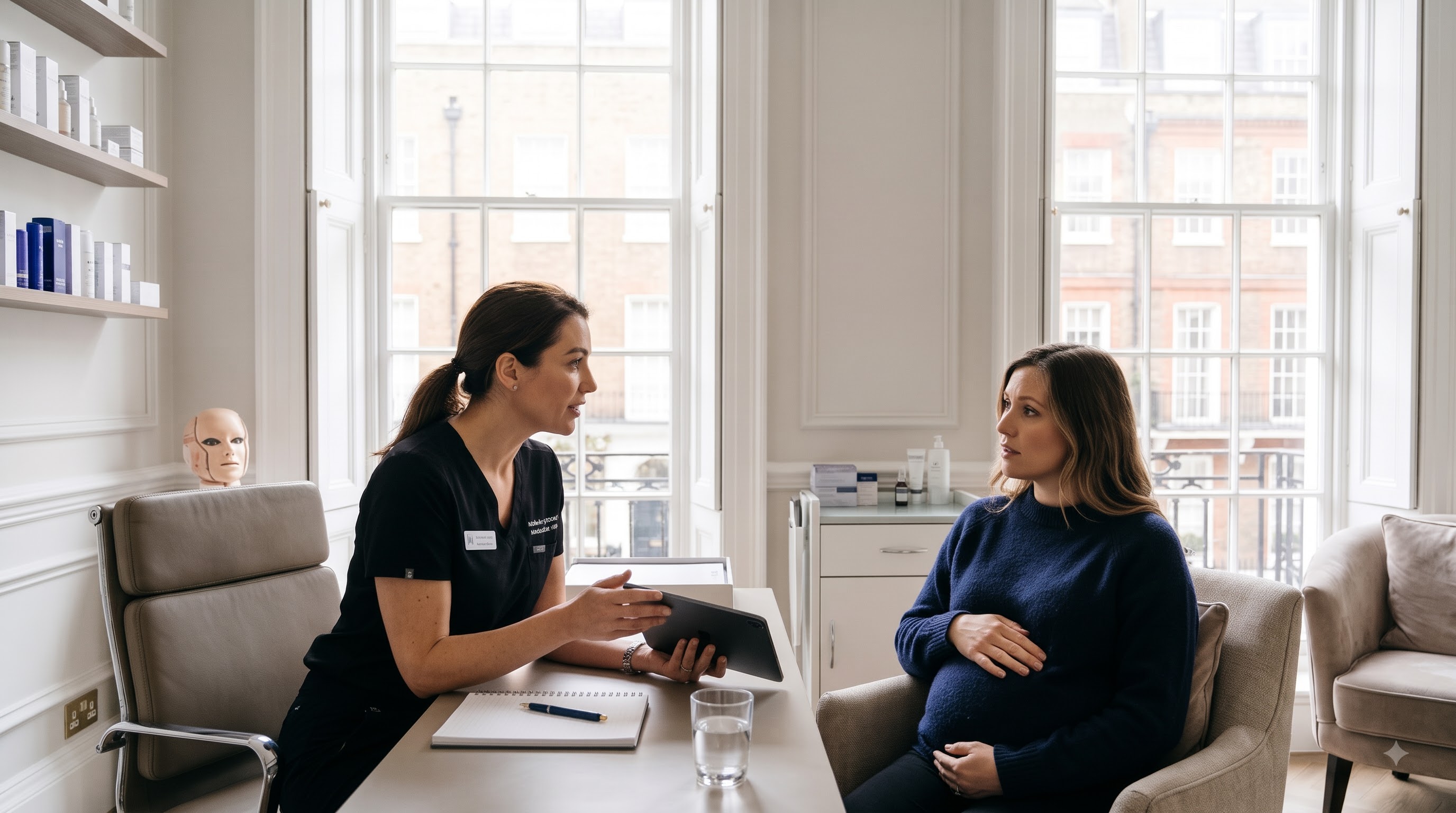
Doctors don't recommend Botox during pregnancy or breastfeeding. There aren't enough human studies to prove it's safe for your baby, so Health Canada and the FDA both advise against it.
This guide explains what the research really shows, what to do if you had Botox before you knew you were pregnant, pregnancy-safe skincare alternatives, and when you can return to treatments after your baby arrives.
Botox Treatment in London for Expecting Mothers
If you're pregnant in London and wondering about Botox, you're not alone. It's one of the most common questions we hear at our medical spa in London, Ontario.
The short answer is no. Doctors don't recommend Botox while you're pregnant or while you're breastfeeding. The longer story includes why, what the research actually shows, and when you can safely return.
This guide is especially for women in London, Ontario, who want clear answers without scare tactics. We'll walk through every stage of pregnancy, the breastfeeding window, and the smartest timeline for getting back to Botox after baby.
What Botox Actually Is?
Botox is the brand name for a purified form of botulinum toxin type A. In tiny, controlled doses, it relaxes specific muscles. That's how it smooths frown lines, lifts brows, and helps with conditions such as chronic migraines, TMJ tension, and excessive sweating. Our complete guide to Botox treatment in London explains the full process.
The doses used in cosmetic and medical treatments are very small. They're designed to stay local, working only on the muscle where they're injected. But during pregnancy, even tiny amounts of certain substances need extra caution.
Why do doctors in London Recommend Avoiding Botox in Pregnancy?
Without studies, doctors stay on the side of caution. According to the Food and Drug Administration, prescribing information for Botox Cosmetic, the drug is not recommended during pregnancy. Health Canada places it in a similar category.
Animal studies have shown some concerns at very high doses. In rats and rabbits given large amounts of botulinum toxin, researchers saw lower fetal weights and some malformations. The doses were far higher than what humans receive, but the findings are enough for regulators to recommend avoiding it.
There's another reason to be careful. Pregnancy changes how your body handles every substance. Hormones shift, blood volume rises, and your immune system works differently. A medication that's safe at one stage of life may not behave the same way during pregnancy.
What the Botox Treatment Research in London Actually Shows?
Some studies have looked at women who got Botox before they knew they were pregnant. The data isn't perfect, but it's reassuring. Several case reports collected by the National Library of Medicine have followed women who had accidental Botox exposure in the first trimester.
In other words, the evidence is reassuring but not strong enough to call Botox "safe" during pregnancy. Doctors at Aqua Medical Spa follow the same precautionary approach as the rest of the industry. We don't treat pregnant patients with Botox, even though a single past exposure before a positive pregnancy test is unlikely to have caused harm. This is the same conservative approach used by reputable clinics across Canada. It’s also worth separating Botox myths from the facts when you’re reading about safety online.
Should You Go for Botox Treatment in London at Each Stage of Pregnancy?
No. Patients often ask whether Botox might be safer at one stage of pregnancy than another. The honest answer is that no stage is considered safe enough for cosmetic Botox. Here's how each trimester is viewed.
First Trimester (Weeks 1 to 13)
The first trimester is when your baby's organs are forming. This is the most sensitive period for medications and other substances. Most doctors are especially cautious during this stage.
If you had Botox in the first few weeks of pregnancy before you knew, talk with your Obstetrician-Gynecologist (OB-GYN). The good news is that current research has not linked a single, small dose to harm. But you and your doctor should review the exposure together.
Second Trimester (Weeks 14 to 27)
Some patients hope Botox is safer once the major organs have formed. The answer is still no. Your baby continues to grow and develop in important ways during the second trimester, including brain, nerve, and muscle development.
Since Botox works on nerves and muscles, doctors prefer to avoid any exposure during this period. There's no clinical reason to take a known unknown when you can simply wait.
Third Trimester (Weeks 28 to Birth)
Late pregnancy isn't a safe window either. Your baby's brain is growing fast. Your body is also preparing for labour, and any substance that affects muscles is something doctors want to avoid.
Some women hope to start Botox before delivery to look refreshed for newborn photos. We understand the wish, and we're sympathetic. But it isn't worth the risk. Wait until your baby arrives and you've finished nursing.
What If You Had Botox Before You Knew You Were Pregnant?
This is one of the most common worries we hear. You had your usual top-up, then a positive pregnancy test surprised you a few days later. Take a deep breath. Most women in this situation go on to have healthy babies.
The first step is to tell your OB-GYN about the exposure. They can document it and answer your specific questions. Bring your treatment records if you have them, including the date and the area treated.
You should not schedule any more Botox until pregnancy and breastfeeding are behind you. Cancel any upcoming appointments and let your provider know you're expecting. Most ethical clinics in London, including Aqua Medical Spa, will gladly pause your treatments until it's safe to come back.
Botox and Breastfeeding: What You Need to Know
Breastfeeding is the second phase when Botox is not recommended. Many patients assume that once the baby is born, it's safe to resume. That's not quite right.
The LactMed database, maintained by the National Library of Medicine, summarizes what's known about Botox and breast milk. The molecule is large, and it likely doesn't pass into milk in any significant amount. But formal studies on nursing women haven't been done.
Because of this gap in evidence, most providers in Canada wait until breastfeeding ends to resume Botox. Some women breastfeed for six months, others for two years, and others not at all. Your timeline depends on your nursing plan.
At Aqua Medical Spa, our team will ask about your breastfeeding status during every consultation. We never treat patients who are actively nursing. Once you've fully weaned, you can return for treatment after a brief recovery window.
If you have a strong personal reason to consider Botox during breastfeeding, talk to your OB-GYN and your pediatrician first. They know your full medical picture. Some women may decide, with their doctors' guidance, that the risk is acceptable. But that's a private medical conversation, not a cosmetic one.
Medical Botox During Pregnancy: Migraines, TMJ, and Hyperhidrosis
Botox isn't only cosmetic. It is used to treat real medical conditions, including chronic migraines, chronic headaches, TMJ disorder, jaw clenching, neck pain, tinnitus, and excessive sweating (hyperhidrosis). For patients who rely on it for these conditions, pregnancy creates a tougher choice.
Can You Avoid Botox During Pregnancy with a Serious Medical Condition?
Cosmetic Botox is easy to pause for nine months. But what about a woman whose Botox keeps disabling migraines under control? Or someone whose hyperhidrosis makes daily life difficult to manage?
For medical conditions, the decision is made between you, your OB-GYN, your neurologist (for migraines), and your treating physician. Some patients pause treatment during pregnancy and manage symptoms with safer alternatives. Others, even in serious cases, may continue treatment under close medical supervision.
The principle is the same across all treatments: the benefit must clearly outweigh the potential risk, and the call must be made with your full medical team.
We don't make this decision alone at our London clinic. Any pregnant patient with a medical Botox history needs guidance from her wider care team. We always defer to your OB-GYN and the specialist managing your condition.
What are the Safe Skincare Alternatives to Avoid During Pregnancy?
You may still have skin concerns during pregnancy. Hormones can cause melasma (dark patches), acne flare-ups, oilier skin, or new sensitivities. You don't have to ignore them. You need pregnancy-safe approaches.
Most dermatologists agree on a few safer options. Gentle cleansers, fragrance-free moisturizers, and mineral sunscreens (zinc oxide or titanium dioxide) are generally considered safe during pregnancy. Sunscreen is especially important for preventing melasma, sometimes called the "mask of pregnancy."
Some ingredients should be avoided. Retinoids, high-strength salicylic acid, and hydroquinone are top ingredients to limit or skip during pregnancy. Always check with your OB-GYN before starting a new product.
Most in-clinic cosmetic treatments are also paused during pregnancy. That includes chemical peels, laser treatments, IPL, microneedling, and dermal fillers. Pregnancy is a season to support your skin gently and save more active treatments for later. Many of our London patients use this time to plan their post-pregnancy treatment journey. If you’re curious, you can read about when to start preventative Botox as part of that planning. We’re happy to schedule a consultation around your expected breastfeeding end date.
When Can You Resume Botox After Pregnancy?
Here's the good news. After you've finished pregnancy and breastfeeding, you can return to your regular Botox routine.
The most common question we hear is: "How soon after delivery can I get Botox?" The answer depends on whether you're breastfeeding. If you're not nursing, most doctors say you can resume Botox once you've fully healed from delivery, which usually means after your six-week postpartum checkup. If you're breastfeeding, you'll wait until you've stopped nursing.
Some patients prefer a short waiting period after weaning before resuming Botox. There's no formal guideline on this, but a few weeks for milk supply to fully dry up is a reasonable buffer. Talk with your provider at our London medical spa about a timeline that fits your situation.
Hormones also play a role. Your skin and muscles take time to settle after pregnancy. Some women find that their facial expressions, fine lines, and skin texture change after pregnancy. We often suggest waiting until hormones have stabilized before starting a new treatment plan, so you can check clearly which areas need attention.
If you had Botox regularly before pregnancy and stopped during it, your muscles have most likely returned to their pre-treatment state. Your first post-baby session may use a similar dose as before, but our team will assess your face fresh and customize the plan for the new chapter.
Are You Planning Botox Treatment in London Around a Future Pregnancy?
If you're planning to get pregnant in the next few months, you may wonder how soon before conception you should stop Botox. There's no strict rule, but most providers suggest stopping at least three months before trying to conceive.
This gives your body time to clear the toxins. Botox effects typically wear off in three to four months. Waiting that long means your last treatment is fully out of your system before pregnancy begins.
Some women plan their final pre-pregnancy Botox session strategically. They time it so they look refreshed for engagement photos, weddings, or special events, then pause once they start trying. Our team is happy to help you map out a timeline. You can also review how much Botox costs in London to budget for your final session.
If you become pregnant unexpectedly between sessions, don't panic. Inform your OB-GYN, document the exposure, and pause future appointments.
Frequently Asked Questions
1. Can I get Botox in my first trimester if I didn't know I was pregnant?
A single accidental exposure during early pregnancy has not been linked to a clear pattern of harm in the studies done so far. Once you know you're pregnant, stop all future Botox sessions and tell your OB-GYN about the exposure.
2. Is Botox safe in the second trimester?
No. While the major organs have formed, your baby continues to grow and develop throughout pregnancy, including brain, nerve, and muscle development. Doctors don't recommend Botox at any stage.
3. Does Botox cross the placenta during Pregnancy?
The Botox molecule is very large, and current research suggests it doesn't cross the placenta in meaningful amounts. However, formal human studies are limited, which is why doctors take the precautionary approach.
4. Can I breastfeed after getting Botox by mistake?
Most experts believe the risk is very low. The molecule is too large to enter breast milk in any meaningful amount. Still, talk to your pediatrician and OB-GYN about your specific situation.
5. How long should I wait after delivery to get Botox if I'm not breastfeeding?
Most providers suggest waiting until your six-week postpartum checkup and full physical recovery. After that, you can usually resume Botox safely. When you do, remember what not to do after Botox to protect your results.
6. Can I get Botox while pumping breast milk?
Pumping doesn't change the recommendation. As long as your baby is drinking your milk, Botox is generally not advised. Wait until you've fully weaned.
7. What about Botox for chronic migraines during pregnancy?
Medical Botox for migraines is a separate conversation between you, your OB-GYN, and your neurologist. In rare cases, doctors may continue treatment if migraines are severe and other options have failed. The decision is always individual.
8. Can I get dermal fillers instead of Botox during pregnancy?
No. Dermal fillers are also not recommended during pregnancy or breastfeeding. Most cosmetic injectables, including PRP and lipodissolve, are paused throughout this entire period.
9. Will pregnancy change how Botox works on me later?
Not directly. But pregnancy can change your facial expressions, your skin texture, and where you store volume. Your first post-pregnancy Botox plan may look slightly different from your pre-pregnancy plan. If results seem weaker than before, see why your Botox didn’t work.
10. Is medical Botox for sweating (hyperhidrosis) safe during pregnancy?
The same precaution applies. Talk to your physician about non-Botox alternatives such as prescription antiperspirants. Most patients pause treatment until after breastfeeding.
Ready to Plan Your Post-Pregnancy Treatment?
Pregnancy and breastfeeding are short seasons in a long life. Pausing your Botox routine is a small, smart trade-off for your baby's safety and your own peace of mind.
Once you've finished nursing, we'd love to welcome you back. Our team will assess how your face has changed, listen to your goals for this new chapter, and build a treatment plan that fits the version of you who's stepping out of the postpartum window. Contact our London team today to book a consultation around your expected timeline. You can also call us at (519) 681-2800, and we'll help you plan the right comeback.